
TO-DO Today: The Anti-planner ADHD Check-in
How many times have your thought THIS new planner or system is going to finally change me forever? How many apps catch your attention with the pitch "The last planner you'll ever need!" or "This ADHD habit tracker changed my life!"
I'll be honest with you, I've tried a million different tools and systems for productivity: paper planners, digital planners, app-based schedulers, habit trackers, time-blocking spreadsheets, a very ambitious bullet journal phase (I don't want to talk about it).
Every single one of these prescribed systems worked great for a few weeks to a month, and then fell apart when life got in the way. Real life showed up and refused to fit into the template.
the NEW Planner Shame Cycle
There's likely a recurring recipe for failure in your past that goes a little something like this:
New System, YAY! Find a new system (planner, app, habit tracker, gamification, teacher, etc...), get excited and hyper-fixate on setting-up all the new tools.
Maintenance - System works great for a time. this could be a few weeks to a few months, or occasionally years.
Disruption - Even good structures fall out from time to time. For one reason or another - sickness, injury, life event, schedule changes, get bored, ADHD rebellion cycle. When our systems are disrupted and we lose our place.
Guilt/Shame = Delayed Recovery - We begin to feel guilt or shame the longer we let things slide. Blank planner pages stacking up, automated reminders piling up, constantly reminding us of how productive we used to be.
Struggle & Numb - Until we find the next New System. Repeat.
The Problem with Habit Trackers & Planners
The REAL problem is that our system became was a bit too complex to jump right back in where we left off. It's gone stale and would take time and energy we do not have to reboot. remember that we are recovering from an upset, some kind of disruption and are no longer motivated by the hyper-fixation from the excitement we felt from finding the new system.
Here's what I eventually figured out, the hard way: the problem was never my follow-through. The problem was that I was using systems designed for brains that aren't mine, had a high degree of complexity to set-up, and was too hard to recover when structures fell out.
So I built something different that I can recover much faster. It's starts fresh every week. If I miss a few weeks, I can start from scratch with the same process.
Introducing TO-DO Today, The ADHD Check-In
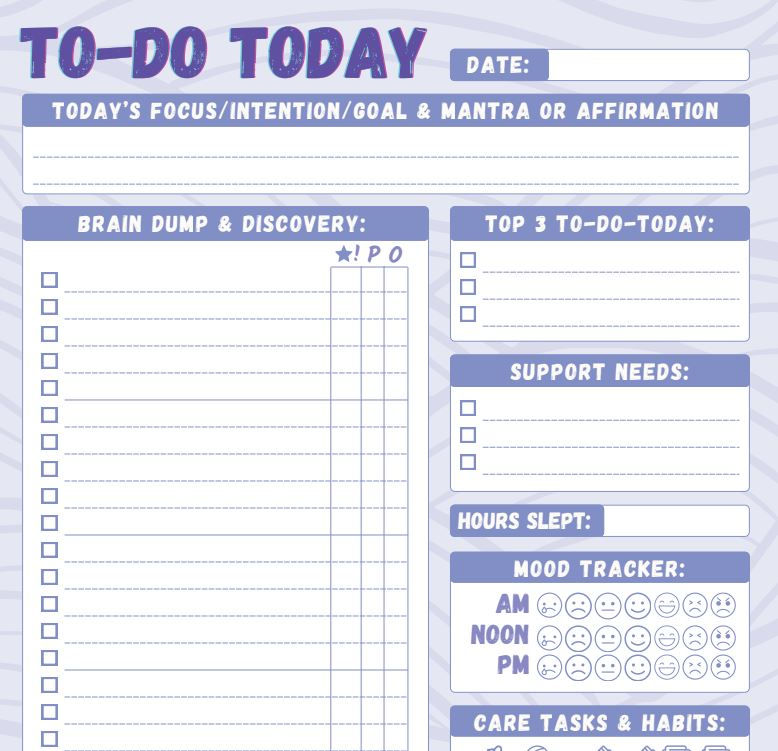
The reason I call it an ADHD check-in is because you are a person who has been out in the world all week, and you deserve a moment to ask yourself how you actually are before you start demanding things of yourself again.
The check-in has three pillars: Goals, Support Needs, and Opportunities. Everything else orbits those three. When I find myself staring at a blank page on a Sunday night, completely unable to figure out what I'm supposed to be doing with my life (a very ADHD Sunday evening activity, highly relatable), this is where I start.
📋 Check-In Checklist
🎉 Celebrate Wins: What were your wins for the week?
🧱 Challenges: What were you hoping to get done this week that you didn't get to? What were your biggest challenges/barriers?
🎯 Focus: What are your goals/intentions/focus for the coming week?
🧠 Brain Dump: You do not need to share this with me, but write out a full brain dump of all of the tasks and projects on your mind.
🏆 Top 3: What are the top three most important tasks, that if you completed them you'd feel your week was a success. (Pick Only 3)
🤝 Support Needs: What do you need to succeed (sensory, body-dou le, emotional, etc...)
✨ Opportunities: What resources, tools, opportunities are open to you today?
🎉 1. Celebrate Wins First
I know it feels indulgent or like you're wasting time you "should" be spending Getting Things Done. However, your brain has very likely spent your whole life berating your and cataloguing everything that went sideways, everything that fell through, every dropped ball and missed deadline. It does this automatically, without being asked, with extraordinary efficiency.
So we have to be deliberate about the wins. Write them down. All of them. Even and especially the small ones.
🧱 2. Challenges - Name What Got Blocked
What were you hoping to do this week that didn't happen? What got in the way?
This is not a shame spiral. This is data.
When I ask this question, I'm looking for patterns - not character flaws. Did tasks keep sliding because they were too vague? Because I underestimated the energy they'd take? Because I needed something from someone else first and didn't realize it? The barriers are almost always telling me something true about what I actually need.
🎯 3. Focus - Set Your Goals & Intentions
Here's where we talk about goals - but specifically, the right kind of goals for this kind of brain. I keep mine anchored to Life Areas. Not a master list of every project I'm theoretically working on. Just 2-3 areas of my life that genuinely need attention this week - career, home, creative work, health, relationships - and one concrete goal from each.
🧠 4. Brain Dump
ADHDers often need to do a full brain dump of everything that's on their mind BEFORE we can organize our selves.
This step is for you. Not for me, not for accountability, not for sharing - just for you.
Get everything out of your head and onto a page. Every task, project, nagging half-thought, thing-you-said-you'd-do, things around your house that you have been avoiding or tolerating for too long. All of it.
You can do whatever you want with the list after, but first get it out of your head and onto the page.
The goal isn't to organize it yet. The goal is to stop your brain from spending its background processing cycles trying to hold it all in RAM. You can do whatever you want with the list after, but first get it out of your head and onto the page.
🏆 5. Top 3 TASKS - Non-Negotiables
Out of everything in that brain dump, what are the top three tasks that would make you feel genuinely good about your week if you got them done?
Three. That's the rule. Not five, not eight, not "well it depends." Three.
Pick only 3. Three. That's the rule. Not five, not eight, not "well it depends." Three. You can always add more once those are done. The constraint is the point.
🤝 6. Blockers & Support Needs
This is an important step that most productivity systems skip entirely, and it is the step that makes or breaks everything else.
What do you actually need to succeed this week? Not what should you theoretically be able to manage on your own - what do you actually need? Sensory accommodations? A body-double for the tasks your brain keeps sliding off? Someone to help you think something through? Permission to rest?
I keep a list of feeling words and a list of needs words on my phone specifically for this step. The outer expression - frustration, avoidance, dread - is almost always pointing at something underneath it. Love and acceptance that's going unmet. Safety that's missing. Connection that's been neglected.
Recalibrating expectations of yourself is not failure. It is executive functioning. It is the skill.
✨ 7. Opportunities - Look at What's Already Available
Before you decide what you need to go find or build or earn - look at what's already in front of you.
What recent wins or contributions deserve to be celebrated? Have you told anyone? What are you genuinely grateful for this week - top 3? What resources, tools, or opportunities are already available to you right now?
This step consistently surprises me. Half the time the thing I think I'm missing is right there, just not where I was looking.
The Optional Tarot Spread (Hear me out!)
I'm going to make a bit of a fuss here - sorry, I'm 'that infuriating student' today - and acknowledge that tarot is not evidence-based in the way my NVC frameworks are. I know. I have a CS degree. I am aware.
That said, if you want a layer of external spontaneity to shake loose any stuck thinking, pull three cards face-down. One for Goals, one for Support Needs, one for Opportunities. Flip them over one at a time.
The cards aren't telling you the future. They're giving your right brain something to do while your left brain loosens its grip on the plan. What comes up when you sit with the image? What does it remind you of? What does it challenge?
I find the reversal meanings insightful - some people find them confusing. Do what works for you. Whimsy has a place in the system. Play/whimsy is, in fact, a support need.
The Thing Nobody Tells You
You don't have to answer every question every day/week. These are prompts for self-reflection, not a test. Some weeks the brain dump will be three pages long and the wins section will feel like pulling teeth. Some weeks it'll go the other way. Some weeks you'll skip the whole thing and do a five-minute version on a napkin. The check-in works because it's asking the right questions - not because you answered them perfectly.
Have you tried a weekly check-in format before? What worked, what didn't? What does your brain actually need to show up for itself on a Sunday night?
I'd genuinely love to know.
Otherwise, I hope this helps!
--Rachel


